


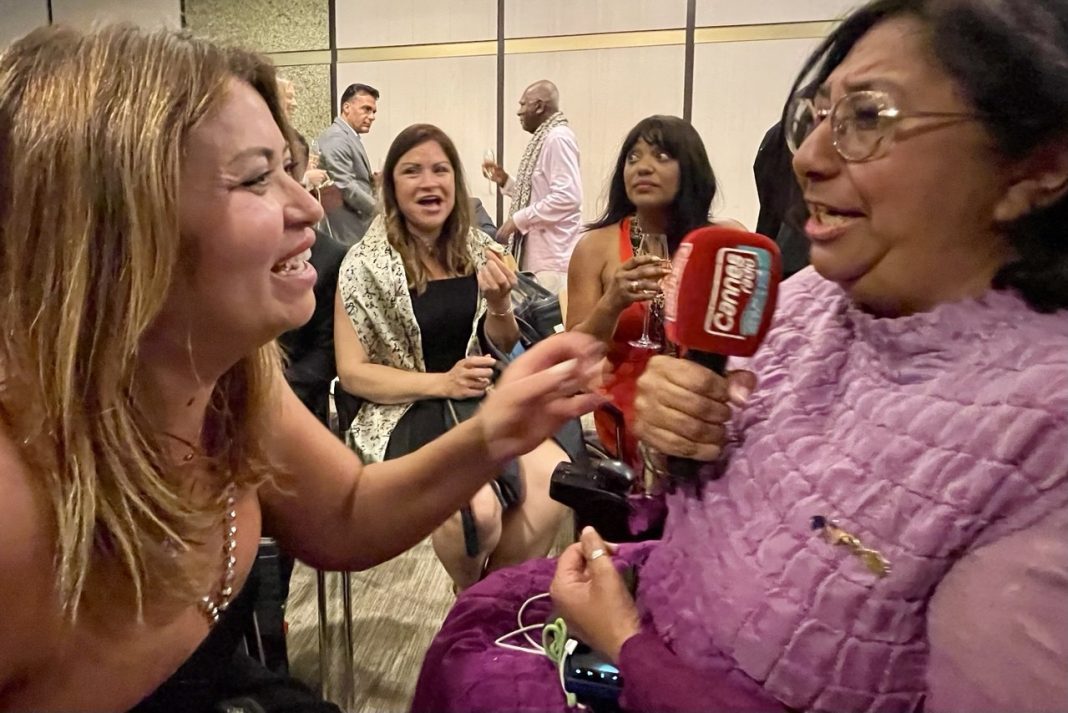
Cannes 2026 — At the Hôtel Majestic Barrière, an intimate Japanese-inspired gathering transformed inclusion into an evening of cinema, art, humour and human connection.
There are evenings in Cannes that are designed to be seen. And then there are evenings that change the way we look.
On the fringes of the Cannes Film Festival and Marché du Film, inside the Japanese poolside lounge of the iconic Hôtel Majestic Barrière, a very different kind of gathering unfolded. Fifty-four guests representing 21 nationalities came together for a private screening and cocktail celebrating HANDIBROKEN FANTOMS (lol), the multi-award-winning mockumentary created and directed by filmmaker Rahma Sophia Rachdi, a director living with a motor disability.
The atmosphere was distinctly Cannes — but with another rhythm. Centuries-old bonsai, delicate sakura, live Japanese calligraphy, premium sake and a Japanese-fusion cocktail created by the Majestic’s chef created a serene counterpoint to the frenetic energy of the Croisette.
Here, disability was not treated as a subject to be discussed from a distance.
It was in the room. It was on screen. And, most importantly, it was celebrated.
A MEETING BORN FROM INTUITION
The story began only weeks earlier, on 5 March 2026, with an encounter between two women whose creative worlds might initially appear far apart.
One was Rahma Sophia Rachdi, filmmaker, disability and representation advocate and creator of HANDIBROKEN FANTOMS (lol).
The other was Miho Saito, Artistic Director of the LVMH Métiers d’Art Japan Residency 2025, and the first Japanese Artistic Director to develop a residency project entirely dedicated to Japan within the Métiers d’Art programme.
Their introduction came through Suna Moya, fashion journalist and former model, and Rahma’s long-time friend. For more than two decades, Moya had accompanied Rahma through the different chapters of her life, before, during and after disability.
Sometimes the most meaningful creative collaborations begin not with a business plan, but with intuition.
By mid-April, the initial idea had transformed into something much larger: why not create a genuine Cannes happening dedicated to disability, inclusion and cinema — at precisely the moment when Japan was the guest of honour of the Marché du Film?
The answer was almost inevitable.
France and Japan, two cultures with profoundly different aesthetics and histories, found common ground in values of dignity, social inclusion, craftsmanship, hospitality and human connection.

And cinema provided the meeting point.
WHEN FRANCE MEETS JAPAN
The evening became a bridge between two creative traditions.
On one side, the irreverent and deeply personal world of French cinema — a world where humour can challenge conventions and where self-mockery becomes a form of freedom.
On the other, the precision, restraint and beauty of Japanese craftsmanship.
The Japanese concept of omotenashi, the art of wholehearted hospitality, became an invisible thread running through the evening.
The setting at the Majestic was therefore far more than a beautiful backdrop.
The hotel is inseparable from the mythology of Cannes cinema: the Croisette, the red carpet, filmmakers, actors and decades of film history.
For Rahma, the choice was intentional. She wanted to welcome her guests — disabled and non-disabled, artists, professionals, friends and allies — in an environment of dignity, softness and prestige.
No separate room. No secondary stage. No symbolic corner.
A place at the centre of the cinematic imagination.
“NOT VIP. V.I.D.”
Perhaps the most provocative idea of the evening was also the simplest.
V.I.D. — Very Important Differents.
“Not VIP: V.I.D. Very Important Differents. Because real distinction is owned difference,” says Rahma Sophia Rachdi.
The expression playfully borrows the vocabulary of luxury and turns it upside down.
At Cannes, where invitations and access can sometimes be measured by status, V.I.D. proposes another hierarchy — one based not on celebrity, wealth or professional power, but on difference, lived experience, sensitivity and courage.
The V.I.D.s become the guests of honour.
Disabled people. Artists. Allies. Film professionals. Friends. Curious viewers.
People who are willing to see cinema — and society — differently.
It is an almost pop-cultural phrase, but beneath the humour lies a serious proposition: difference is not something to conceal. It can be a source of distinction.
WE ARE THE 17%
The evening also gave visibility to the “We Are the 17%” initiative, referring to the estimated proportion of the world’s population living with some form of disability, whether visible or invisible.
The number is enormous, yet disability remains disproportionately absent from the most prestigious cultural narratives.
Too often, disabled people appear as subjects of compassion rather than as protagonists, creators, decision-makers, professionals or consumers of culture.
The message at the Majestic was deliberately different.
The 17% are not simply a statistic. They are audiences. Actors. Directors. Writers. Technicians.Journalists. Producers. Collectors. Entrepreneurs. And future filmmakers.
The objective was therefore not pity, but presence — expressed through cinema, humour, elegance and celebration.
HANDIBROKEN FANTOMS (lol) — LAUGHTER AS A FORM OF REPRESENTATION
At the centre of the evening was HANDIBROKEN FANTOMS (lol), a mockumentary that places disability directly in the spotlight while refusing to treat it as something solemn or untouchable.
Created and directed by Rahma Sophia Rachdi, the film uses self-mockery, humour and stunt-driven energy to challenge the conventional representation of disability.
Its trajectory already speaks loudly: 28 awards, 49 official selections, 17 countries and five continents, according to the film’s current record.
But numbers only tell part of the story.
What makes the project unusual is its refusal to ask for a separate cinematic category simply because its creator has a disability.
Instead, it enters the same arena. The same festivals. The same conversations. The same spotlight.
At the Majestic, HANDIBROKEN FANTOMS (lol) did not ask Cannes to look away from disability.
It asked Cannes to look directly at it — and laugh, think and connect.
A JAPANESE PARENTHESES IN THE MIDDLE OF CANNES
The visual language of the evening was as carefully considered as its message.
DASSAI brought premium sake and the spirit of Japanese hospitality.
Shinya Yamada contributed artworks to the lounge.
KUROKI represented exceptional Japanese denim craftsmanship.
Kyocera contributed textile printing and visual supports.
Osaka Sakura shaped the floral atmosphere.
And Miho Saito provided the overall Japanese artistic curation and direction.
Together, these elements created something that felt less like a conventional industry reception and more like a temporary world: a Japanese-inspired parenthesis floating inside the feverish rhythm of Cannes.
Bonsai beside cinema.
Sakura beside fashion.
Calligraphy beside technology.
Craftsmanship beside contemporary disability representation.
FROM DIFFERENCE TO TECHNOLOGY
Rahma’s work extends beyond filmmaking.
She is also the founder of The Good Samaritan, a digital initiative designed to support people living with reduced mobility, including disabled and elderly people, through assistance, autonomy and geolocation.
The concept reflects a broader philosophy running through her work: inclusion should not exist only as an idea.
It should become infrastructure.
Technology can help connect people, provide assistance and create greater autonomy — particularly for people whose everyday mobility can be restricted by physical or social barriers.
In this sense, the Cannes gathering represented something larger than a film screening.
It was a meeting point between creation, disability, technology, craftsmanship and human solidarity.
THE POWER OF A PLACE
There was also something significant about the location.
The Majestic has long been associated with the visual language of cinema: glamour, premieres, stars, fashion and the rituals of Cannes.
To bring a disability-focused film into that environment was itself an artistic gesture.
It shifted the frame.
Disability was no longer positioned outside the glamorous world of cinema, waiting to be invited in.
It was already there. Dressed for the occasion. Welcoming guests. Showing a film. Creating art. Drinking sake. Laughing. Networking. Being part of Cannes. Exactly as it should be.
FROM ONE CONVERSATION TO AN INTERNATIONAL PLATFORM
The speed with which the evening came together is perhaps one of its most remarkable details.
From the first conversation on 5 March to the event on 18 May, barely ten weeks separated intuition from reality.
What began as a potential collaboration between Rahma Sophia Rachdi and Miho Saito became a cross-cultural artistic happening involving France, Japan and an international community of guests.
The evening generated 35 post-event screener requests, suggesting that the curiosity did not end when the cocktails were finished.
Meanwhile, the film’s international festival journey continues, with selections and submissions including TNFF, the Mostra di Venezia, The Red Festival, Love & Hope Festival Barcelona and Ice Movie Awards Courchevel.
THE NEW CANNES FORMULA
Perhaps the most interesting thing about this gathering was that it did not feel like an “inclusion event”.
It felt like a Cannes event.
That distinction matters. Because inclusion becomes truly powerful when it no longer requires a separate room. When disability does not need to be explained before someone is allowed to participate. When technology serves humanity rather than replacing it. When craftsmanship and contemporary creativity speak the same language. When humour can dismantle discomfort.
And when a filmmaker with a disability can stand at the Majestic and say, in effect:
I am not asking for a place outside the frame. I am part of the frame.
Cannes has always been fascinated by difference — by unusual voices, new visions, unexpected stories and people who refuse to fit neatly inside established categories.
Perhaps this is the next evolution of the Festival spirit.
Not simply to celebrate the people who have traditionally occupied the spotlight, but to widen the frame until more of humanity can see itself reflected there.
On that May evening at the Majestic, France and Japan offered their own answer.
A little cinema. A little craftsmanship. A little technology. A great deal of humour.
And, above all, people meeting people.
Because sometimes the most memorable red carpet is the one that does not need a red carpet at all.



 brought cinema, disability, Japanese craftsmanship and technology together at Hôtel Majestic Barrière.)