

At Art Basel 2025 in Basel, Switzerland, one of the most ambitious artistic gestures unfolded not inside the fairgrounds, but across the expansive Messeplatz plaza. German artist Katharina Grosse was commissioned to create CHOIR, a site‑specific, large‑scale painting that transformed the square and surrounding structures into a sweeping vision of colour, movement, scale and perception — a work that became one of the most talked‑about public art projects of the fair.
In a conversation during the week of Art Basel, Grosse spoke about her approach to the project, how she works with space and colour, and what it means to make painting itself the subject of a monumental public intervention.
Interviewer: Katharina, how did you approach a site like Messeplatz? It’s not a gallery wall — it’s a public square that thousands of visitors pass through every day.
Katharina Grosse:
Messeplatz presented a unique challenge and opportunity because it’s already a place of passage and energy. People walk in different directions — they’re thinking about their plans for the day, where they’re going next. They’re not coming to a painting. They’re walking through a space. I wanted to use colour in a way that interrupts that routine, so the work doesn’t just hang somewhere; it becomes somewhere. You enter it with your whole body.
Painting for this project is not about marking a surface; it’s about creating a bodily experience. When you’re surrounded by colour, when it unfolds across the floor, the façade, the fountain — the painting becomes architecture, becomes movement, becomes sensation.
Interviewer: Why choose the colours you did — especially the magenta and white that dominate CHOIR?
KG:
Colour is everything in this context — it’s what people see first, what grabs attention in an environment filled with distraction. Magenta was chosen because it’s one of the most visible colours to the human eye outdoors. I wanted something that doesn’t just sit on the surface, but speaks to your perception the moment you see it. In this context — where people are often thinking about exhibitions, sales, meetings — colour becomes a physical language that brings them into the work.
Interviewer: Can you walk us through your experience making CHOIR — what was the process like?
KG:
It took about six days to complete, working directly on the square and surrounding architectural surfaces with industrial spray guns and acrylic paint. You can’t control everything — the wind, the light, the people walking through — and I don’t want to. Part of how CHOIR works is that it exists with all those variables. It’s an immersive environment, not just a static painting on a wall.
To me, painting in this scale is like a performance: the spraying, the gestures, the movement across surfaces, is all about immediacy and intuition. Sometimes I go fast, sometimes I step back and look, and then I make the next decision. It’s a negotiation between control and freedom.
Interviewer: This piece will only be on view for the duration of the fair. How do you think this ephemerality shapes the work?
KG:
Exactly — it is temporary, and that is part of its power. Art Basel is a fair — it’s about commerce, about transactions — and here we have something that can’t be bought, sold, owned. It dissolves when the fair ends. That fragility is very intentional. It’s almost like a breath: it’s here, you walk through it, and then it’s gone. That’s the kind of experience art should offer sometimes — an encounter rather than an object.
Interviewer: How do you think visitors are experiencing CHOIR? What do you hope they take away from it?
KG:
I think people experience it physically first — they see the colour, they step into it, they are surrounded by it — and then they begin to feel it. Colour doesn’t just hit your sight; it hits your body. Here in Basel, people aren’t spectators; they’re participants. And because the work envelops them, their own movement becomes part of the painting.
I want people to feel a sense of awareness — a moment where something familiar becomes unfamiliar, where the everyday context is changed by imagination. It’s like stepping into a new world for a brief moment. That’s what painting can be.
About CHOIR and the Messeplatz Project
Titled CHOIR, Katharina Grosse’s installation covered an expanse of more than 53,000 square feet (about 5,000 square meters) — making it the largest public painting she has created to date. The work used magenta and white acrylic paint sprayed directly on the asphalt, architectural surfaces and surrounding plaza, transforming the familiar urban square outside the Art Basel exhibition halls into a vivid, chromatic work of art that resisted easy categorization.
Curated by Natalia Grabowska — Curator at Large for architecture and site‑specific projects at the Serpentine Gallery in London — the project was one of the standout public art commissions of the 2025 fair.
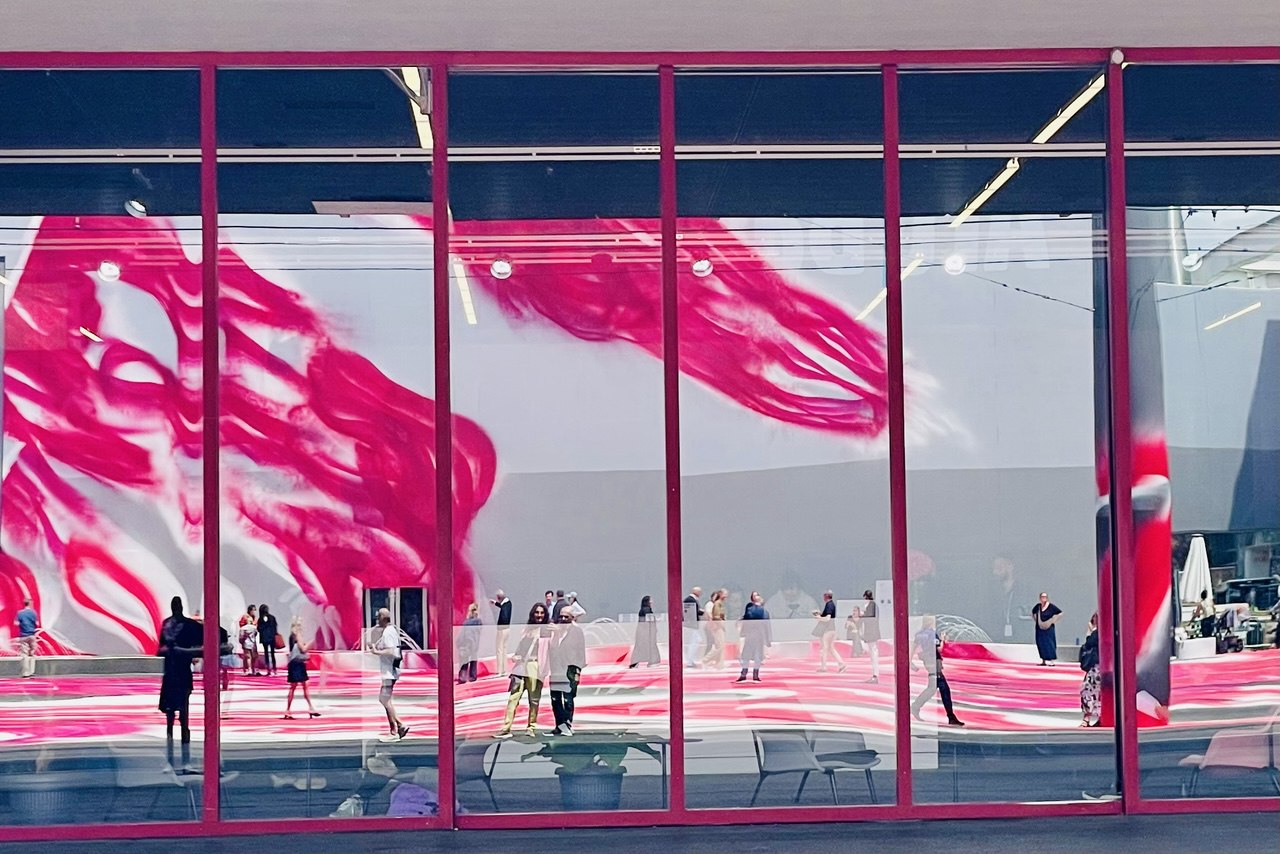
Unlike typical gallery works, CHOIR was not for sale, could not be preserved, and will disappear when the fair concludes — emphasizing the ephemeral potential of painting in a context dominated by art objects as commodities.
The Vision Beyond Art Basel
Katharina Grosse’s work exemplifies how painting can expand beyond the canvas, engaging urban space, architecture and viewer movement in ways that challenge conventional boundaries. At Art Basel 2025’s Messeplatz, she redefined what it means for a work of painting to be site‑specific — not merely placed, but woven into the fabric of public life, however briefly, inviting viewers to enter, move through and emerge transformed by colour.