
An Interview with a Global Voice of Post-War Japanese Contemporary Art
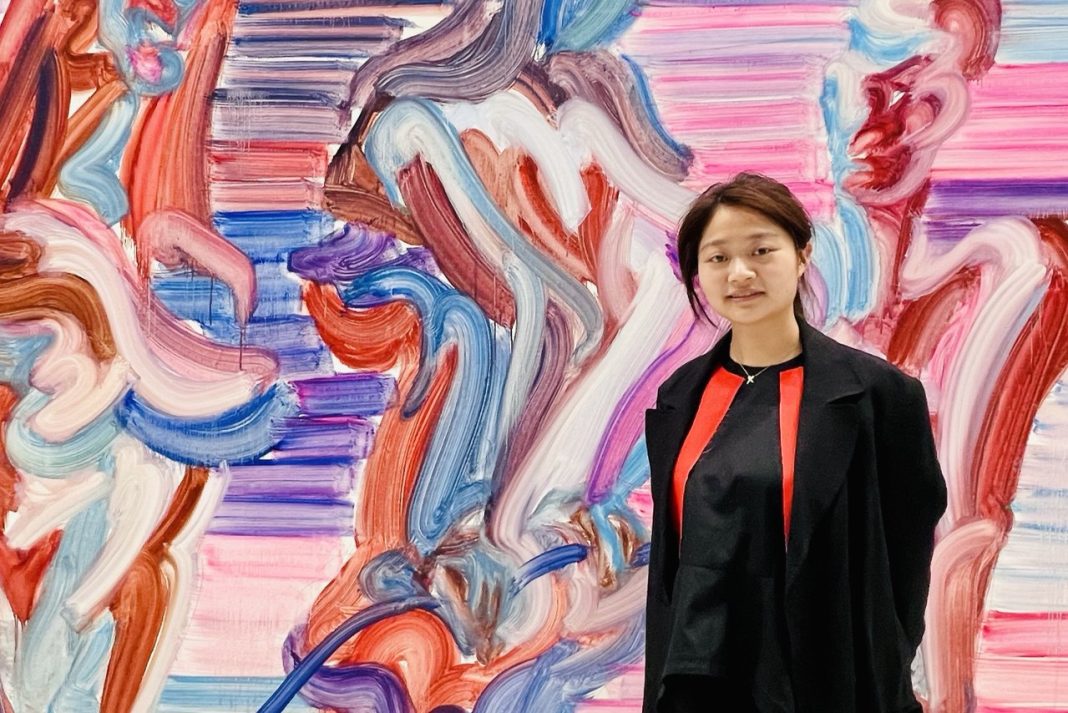
Etsu Egami represents a generation of Japanese artists shaped not by one geography, but by many. As part of the third generation of post-war Japanese contemporary artists, her practice moves fluidly between East and West — intellectually, culturally, and visually.
Active across Japan, China, the United States, and Europe, Egami’s work reflects a world in constant motion. Educated at Karlsruhe University of Arts and Design (HfG) in Germany and the Central Academy of Fine Arts in Beijing, she embodies a truly international artistic language — one that recently reached the world of high fashion when one of her prints was used by Dior.
We spoke with Etsu Egami about her journey, her cross-cultural education, and the expanding life of her work.
City for VIP: Etsu, your background spans several continents. How has this shaped your artistic language?
Etsu Egami:
I never felt that my work belonged to one place. Growing up in Japan, then studying in Germany and China, taught me to see painting as a space of translation. Each culture has its own rhythm, philosophy, and relationship to time. My work exists between these systems rather than within one.
A Global Education
Egami’s academic journey mirrors her artistic sensibility. At HFG Karlsruhe, she absorbed the rigor of European conceptual thinking and material experimentation. In Beijing, at the Central Academy of Fine Arts, she encountered a different energy — one rooted in history, calligraphy, and spatial awareness.
This dual education informs her distinctive approach to painting and printmaking: gestural yet controlled, poetic yet analytical.
City for VIP: How did your experience in China influence your practice?
Etsu Egami:
China taught me about scale and historical continuity. Painting there carries centuries of memory. It made me more conscious of gesture — how a single movement can hold meaning. That awareness still guides my work today.
Between Art and Fashion — The Dior Connection
Egami’s work entered a new cultural sphere when one of her prints was selected for use by Dior — a moment that bridged contemporary art and haute couture.
City for VIP: What did it mean to see your work translated into fashion by Dior?
Etsu Egami:
It was interesting because fashion moves differently than art. A painting is still; clothing moves with the body. Seeing my work in that context reminded me that images have lives beyond the studio. Dior respected the integrity of the work while allowing it to transform.
Third Generation, New Questions
As part of the third generation of post-war Japanese artists, Egami does not carry the urgency of reconstruction, but rather the complexity of globalization.
Her work reflects questions of identity, memory, and perception in a world where borders are increasingly fluid — yet still deeply felt.
City for VIP: How do you see your role within your generation?
Etsu Egami:
I think our generation is less interested in defining Japan and more interested in dialogue. We grew up connected to the world. Our challenge is to remain rooted while staying open.
Presence in the International Art World
Egami’s exhibitions and projects across Asia, Europe, and the United States position her as both an observer and participant in global contemporary discourse. Collectors are drawn to her work not only for its visual strength, but for its intellectual depth and cultural resonance.
City for VIP: What are you currently exploring in your work?
Etsu Egami:
I’m thinking a lot about perception — how images are formed, remembered, and transformed across cultures. Painting, for me, is a way of slowing down in a fast world.
Editor’s Note
Etsu Egami’s work speaks quietly, yet travels far. From art academies in Germany and China to international exhibitions and collaborations with Dior, her practice reflects a generation fluent in movement, translation, and nuance.
In a global art landscape, Egami stands as a painter of connections — between cultures, disciplines, and ways of seeing.